Types of Fertility Awareness-Based Methods (FABMs)
It’s highly recommended to work with a qualified Fertility Awareness Educator for at least the first three cycles while learning a Fertility Awareness-Based Method (FABM). It’s important to avoid any mistakes during this time, especially if you are trying to avoid falling pregnant.
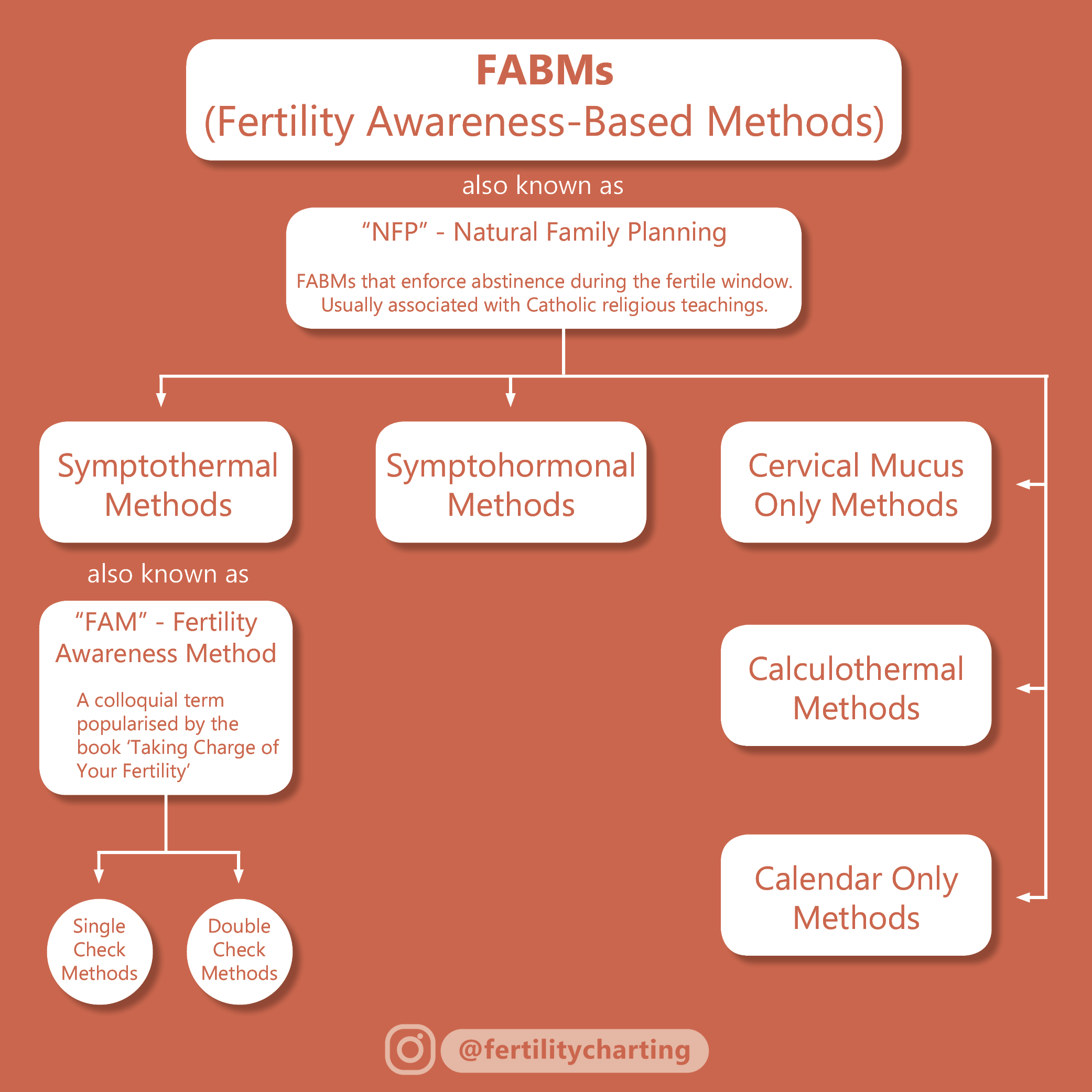
There are five main types of Fertility Awareness-Based Methods:
- Symptothermal Methods
* Single-check
* Double-check - Cervical Mucus-Only Methods
- Symptohormonal Methods
- Calculothermal Methods (not usually recommended)
- Calendar-only Methods (not usually recommended)
What do each of these five types of FABMs involve?
- Symptothermal Methods
Cervical mucus and basal body temperature (BBT) observations. - Cervical Mucus-only Methods
Cervical mucus only. - Symptohormonal Methods
Cervical mucus and urinary hormone metabolite observations (usually via a device known as the Clearblue Fertility Monitor and/or luteinising hormone test strips [OPK’s]). - Calculothermal Methods
Calculations based on previous cycles or population averages, and basal body temperature observations (i.e. Natural Cycles/Daysy etc). These methods are not usually recommended due to their higher failure rates. - Calendar-only Methods
Calculations based on previous cycles or population averages only (i.e. the Rhythm Method). These methods are not usually recommended due to their higher failure rates.
What is the difference between single-check and double-check Symptothermal Methods?
- Symptothermal Single-check Methods
The fertile window is opened with cervical mucus observations. The fertile window is closed with cervical mucus and BBT observations. Not as effective as Symptothermal Double-check Methods - Symptothermal Double-check Methods
The fertile window is opened with cervical mucus observations and calculations based on past cycle lengths or temperature shift dates. The fertile window is closed with cervical mucus and BBT observations. Symptothermal Double-check Methods are more effective than Symptothermal Single-check Methods.
Within each of the above methods, there are numerous protocols that are taught by both secular and religious organisations. Religious organisations may or may not include religious teachings on sexuality and morality. Religious methods are often referred to collectively as “Natural Family Planning” methods, or NFP (instead of Fertility Awareness-Based Methods).
Different methods are often suited to different stages of your life as you move from menarche to menopause, potentially experiencing postpartum life in-between. Different methods will also suit different lifestyles and health issues. For example, those who suffer insomnia might avoid Symptothermal Methods, and those who are in the postpartum period or who experience confusing cervical mucus patterns, might try Symptohormonal Methods.
An experienced instructor will be able to guide you toward a method most suited to your situation.
It’s very common to hear about a 99.4-99.6% effectiveness rate when learning about Fertility Awareness-Based Methods. This rate is based off a study of the Sensiplan Method. The Sensiplan Method is a Symptothermal Double-check Method and was found to be 98.2% effective with typical use, and 99.6% effective with perfect use. These rates were based on regular and ongoing contact with a qualified instructor. The self-taught method outlined in the book ‘Taking Charge of Your Fertility’ by Toni Weschler is a Single-check Method closer to 98% effective with perfect-use, as discussed by Toni in Appendix D of her book.
Nearly all of the organisations below offer variations of their core method. For example, Marquette and Boston Cross Check offer countless variations within their protocols as users can choose from rules that combine cervical mucus, temperature and hormone testing (Estrogen and LH) in different combinations. Contact the organisation you are interested in working with for more information.
Please note that this is not an exhaustive list of FABM methods/organisations.
To find out about the effectiveness rates of different Fertility Awareness-Based Methods, you may like to read this systematic review that was released in the journal of Obstetrics & Gynecology in Sep 2018: Effectiveness of Fertility Awareness-Based Methods for Pregnancy Prevention: A Systematic Review.
SYMPTOTHERMAL METHODS
Sensiplan
A Symptothermal Double-Check Method founded in Germany in the 1980s by the Arbeitsgruppe NFP at the international aid agency Malteser International, with support from the German Ministry of Health. Secular with Catholic origins.
Natural Family Planning Teachers Association (United Kingdom)
A Symptothermal Double-Check Method established by gynaecologists Dr. John Kelly and Dr. Anna Flynn who began teaching the method in 1976 at the Birmingham Maternity Hospital in the United Kingdom. Secular with Catholic origins.
Fertility UK
A Symptothermal Double-Check Method founded by fertility nurse Jane Knight in the United Kingdom. Jane Knight trained under Dr. Elizabeth Clubb in the 1970s and the Fertility UK training is often provided via NHS services. Secular.
Natural Fertility NZ
A Symptothermal Double-Check Method established in 1974 in New Zealand and further bolstered by NZ Department of Health government grants in 1980. Secular.
SymptoPro Fertility Education
A Symptothermal Double-Check Method developed by Mike and Rose Fuller in collaboration with Dr. Josef Roetzer in 1977. SymptoPro is a Catholic organisation based out of the United States.
Couple to Couple League
A Symptothermal Double-Check Method founded in 1971 by John and Sheila Kippley in collaboration with Dr. Konald Prem. Couple to Couple League is a Catholic organisation based out of the United States.
Natural Family Planning International
A Symptothermal Double-Check Method founded in 2004 by John and Sheila Kippley. The Kippley’s originally founded the Couple to Couple League, and brought over 30 years’ experience to the founding of NFPI. NFPI is a Catholic organisation based out of the United States.
SymptoTherm Foundation
A Symptothermal Double-Check Method founded in the mid-2000s by Harri Wettstein and Christine Bourgeois in Switzerland. Focus is on use of the Sympto app algorithm. Secular.
Seréna
Seréna is a non-profit Catholic foundation established in 1955. Seréna is country-wide in Canada and serves the English-speaking provinces. Seréna Quebec is secular, and has branched off to teach primarily to French speakers, although they hold English sessions too. Includes some Double-Check aspects and a basic temperature protocol.
Natural Fertility Education Australia
A Symptothermal Single-Check Method founded by Dr. Kerry Hampton, fertility nurse academic in Melbourne. Dr. Hampton originally trained in the Billings Ovulation Cervical Mucus-Only method in 1991 before founding Wise Woman Business to teach Natural Fertility Education. Natural Fertility Education is a secular method with a strong focus on cervical mucus and sensation charting, with some Double-Check aspects and a basic temperature protocol.
Justisse
A Symptothermal Single-Check Method developed in 1987 by Dr. Geraldine Matus. Matus originally trained with the Billings Ovulation Method, Seréna Canada, Couple to Couple League and Creighton before establishing the Justisse Method to provide a secular fertility awareness option in Canada. Primarily health and cervical mucus-focused, with a basic temperature protocol.
The Well (formerly Grace of the Moon)
A Symptothermal Single-Check Method founded in 2011 by midwife Sarah Bly. The Well is a secular organisation based in the United States. Primarily health and cervical mucus-focused, with a basic temperature protocol and some Double-Check aspects.
Taking Charge of Your Fertility (book)
A Symptothermal Single-Check Method outlined by Toni Weschler in the book Taking Charge of Your Fertility. Designed to be self-taught, although there are a group of TCOYF-trained educators available in Israel.
CERVICAL MUCUS-ONLY METHODS
Billings Ovulation Method
A Cervical Mucus-Only Method founded in 1953 by Drs John and Evelyn Billings in Australia. The Billings Ovulation Method primarily focuses on walking sensation at the vulva to establish patterns of fertility and infertility during the menstrual cycle. It is a Catholic method and one of the most comprehensive Cervical Mucus-Only methods available.
The Creighton Model
The Creighton Model is a Cervical Mucus-Only Method founded in the 1970s by Dr. Thomas Hilgers and nurses Diane Daly and Ann Prebil. The Creighton Model is a modification of the Billings Ovulation Method and focuses on categorisation of visual cervical mucus using numbers and letters, in addition to wiping sensation (as opposed to walking sensation). The Creighton Model also has an associated NaPro Technology medical branch with a network of medical and surgical providers trained to read charts for diagnoses purposes. The Creighton Model is a Catholic organisation based in the United States.
SYMPTOHORMONAL METHODS
FEMM Method
Fertility Education and Medical Management (FEMM) Method was founded by Anna Halpine of religious organisation World Youth Alliance. With a focus on cervical mucus observations in combination with the use of luteinising hormone test strips, FEMM has a strong focus on health tracking. FEMM also has an affiliated Reproductive Health Research Institute with a network of Medical Management providers trained to read charts for diagnoses purposes. FEMM is based in the United States and is a secular method with a Catholic background.
Marquette Method
A Symptohormonal Method incorporating urinary hormone metabolite testing of oestrogen and luteinising hormone levels via the Clearblue Fertility Monitor (with optional cervical mucus and temperature protocols). The Marquette Method was developed by Dr. Richard Fehring and a team of physicians and researchers from Marquette University in 1999. The Marquette Method is a Catholic method based out of the United States.
Boston Cross Check Method
A Symptohormonal Method incorporating urinary hormone metabolite testing of oestrogen and luteinising hormone levels via the Clearblue Fertility Monitor (with optional cervical mucus and temperature protocols). The Boston Cross Check Method is a Catholic method based out of the United States.
Click on the links below to visit method organisation websites directly
NFPTA-UK (Natural Family Planning Teachers Association of the United Kingdom)
NFNZ (Natural Fertility New Zealand)
NFPI (Natural Family Planning International)
Natural Fertility Education Australia
The WELL (Formerly Grace of the Moon)
Justisse Healthworks for Women
FEMM (Fertility Education and Medical Management)
Creighton FertilityCare System
BOMA (Billings Ovulation Method Association)
Further Resources
FACTS (Fertility Appreciation Collaborative to Teach the Science) – information and further education for medical professionals.